Prosem Lecture: Over-the-Counter Hearing Aids: Current Status and Future Challenges

62 Goodnight Hall
@ 12:00 pm - 1:00 pm
Learn more about Prosem

The Over-the-Counter (OTC) Hearing Aid Act went into effect in the fall of 2022, making hearing aids available without a prescription from an audiologist. What are OTC hearing aids? Who are they for? How can people with hearing loss successfully use OTC hearing aids? This talk will first review the motivation for, history, and current legal and regulatory status of OTC hearing aids. Then, the challenges, particularly service-delivery and self-fitting, for OTC hearing aids will be discussed. Particular attention will be paid to our recent work in developing hearing aid gain-frequency presets that maximize coverage for the potential OTC user population.

Erik Jorgensen, Au.D, Ph.D.

Hearing and Donuts (Brain and Bagels) Seminar

Waisman Center
@ 8:30 am - 9:30 am
Learn more about the Hearing and Donuts Seminar Series

Community-based approaches support scalability, ecological, and cultural validity of early language intervention research. However, there are often unique challenges including funding, recruitment, maintaining design rigor, and dissemination. This session will highlight the strengths and challenges of community-based research, as well as strategies for reducing barriers, through the lens of two ongoing early language intervention clinical trials, KOALA and DUET.

Rebecca Alper, Ph.D., CCC-SLP

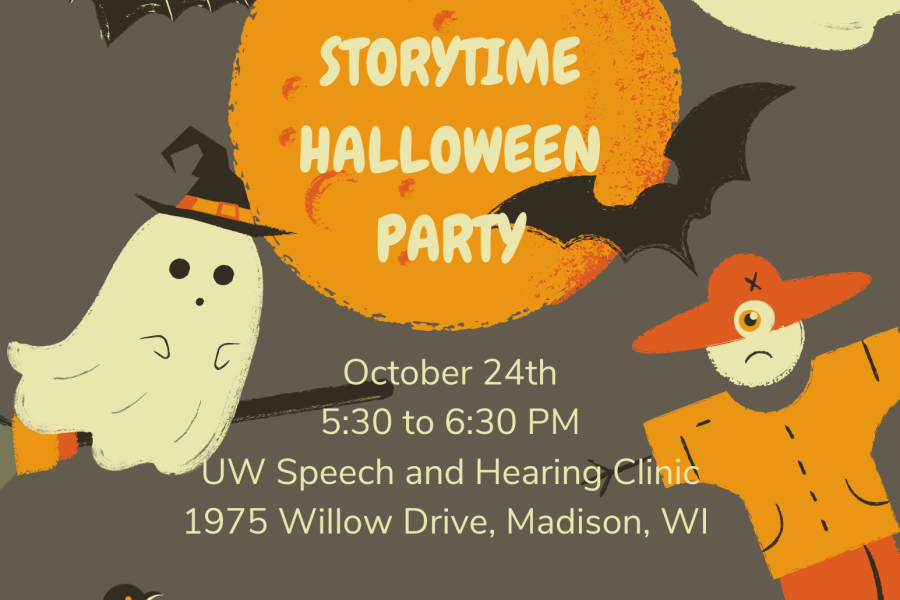
UWSHC Spooky Storytime Halloween Party 2023

UW Speech and Hearing Clinic
@ 5:30 pm - 6:30 pm

UWSHC Spooky Storytime Halloween Party 2023 The UWSHC and the UW-Madison Student Academy of Audiology are hosting a Halloween party on October 24th from 5:30 to 6:30 PM! We hope to see you there!

UWSHC Halloween Flier

Prosem Lecture: Prediction and Early Language in Young Autistic Children

62 Goodnight Hall
@ 12:00 pm - 1:00 pm
Learn more about Prosem

Recent theoretical accounts suggest that differences in the processing of probabilistic events may underlie the core and associated traits of autism spectrum disorder (ASD). These theories hypothesize that autistic individuals are differentially impacted by disruptions in probabilistic input relative to neurotypical (NT) peers. According to this view, autistic individuals assign disproportionate weight to prediction errors such that novel input is overweighted relative to the aggregation of prior input; this is referred to as ‘hyperplasticity’ of learning. Hyperplastic learning may have important implications for autistic children’s language development, as language unfolds in statistically constrained, probabilistic sequences. Prediction among autistic individuals has primarily been examined in nonverbal, visual contexts with older children and adults. The present set of experiments aimed to test whether young autistic children differed from cognitively-matched NT peers in their processing of probabilistic input in a variety of contexts: verbal, visual, and linguistic. Findings from these experiments and implications for theoretical and clinical applications will be discussed.

A W crest banner flutters in the wind on Bascom Hill at the University of Wisconsin-Madison during autumn on Oct. 18, 2019. Photo by Jeff Miller /UW-Madison

Prosem Lecture: Impacts of Aging on Pre-Treatment Swallow Function in Patients with Head and Neck Cancer

62 Goodnight Hall
@ 12:00 pm - 1:00 pm
Learn more about Prosem

Changes to swallow function occur as part of the natural aging process (presbyphagia). Simultaneously, patients diagnosed with head and neck cancer (HNC) often experience impaired swallow function (dysphagia) as a consequence of oncologic treatment. Alterations to safety and efficiency of swallowing have significant impacts on both health status and quality of life. Yet, the relationship between aging and oncologic treatment-related impacts to swallow function in this patient population is relatively unexplored. This work aims to assess how aging may impact swallow-related outcomes in patients diagnosed with HNC via comparison of pre-treatment differences in older vs younger participants within this patient population.

Nicole Schaen-Heacock, M.S., CCC-SLP

Hearing and Donuts (Brain and Bagels) Seminar

Waisman Center
@ 8:30 am - 9:30 am
Learn more about the Hearing and Donuts Seminar Series

In two studies, we applied opposing altered auditory feedback to investigate the word as a potential motor planning unit. In Study 1, speakers learned to produce the same syllable (e.g., “ped”) differently based on the word it belongs to (opposite changes to “pedigree” vs. “pedicure”). In Study 2, learned changes to the production of isolated syllables did not transfer to the same syllables when they were part of a multisyllabic word. Together, these studies strongly suggest the word as a speech motor planning unit.

A W crest banner flutters in the wind on Bascom Hill at the University of Wisconsin-Madison during autumn on Oct. 18, 2019. Photo by Jeff Miller /UW-Madison

Hearing and Donuts (Brain and Bagels) Seminar

Waisman Center
@ 8:30 am - 9:30 am
Learn more about the Hearing and Donuts Seminar Series

This talk will focus on studies aimed at diagnosing hidden hearing loss, understanding the central consequences of hidden hearing loss on neural coding of sounds, and the effects of cochlear synapse loss on speech understanding using a translational approach which combines studies in animal models and human clinical populations. Using non-invasive, auditory evoked potentials as the translational bridge, we study the functional aspects of age-related hearing loss with the goal of designing the next generation of objective neurophysiological biomarkers for assessing changes in hearing in the clinic.

A W crest banner flutters in the wind on Bascom Hill at the University of Wisconsin-Madison during autumn on Oct. 18, 2019. Photo by Jeff Miller /UW-Madison